


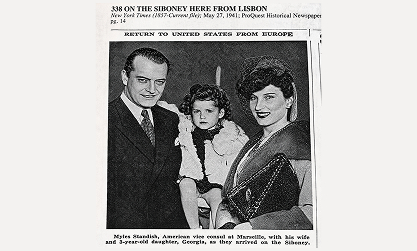
It started with a phone call I almost didn’t think twice about. A historian with the U.S. Department of State had been researching an article on two American diplomats who worked in France during the Second World War. One of them, she told me, was my grandfather, Myles Standish. She’d found our family tree online while chasing down details for her piece, and she had one simple request: did the family happen to have a photograph of him?
I remember standing in my kitchen, phone against my ear, saying something like, “I’ll have to check with my aunt.” I hung up expecting that to be the end of it. A photo, sent off, a polite thank-you, and back to my normal life.
It was not the end of it.
The Man The Family Knew
His children called him Pooh, a formal man in a three-piece suit who made seafood paella on Sundays and had opinions about nearly everything. He was charming, a little vain, endlessly certain he was right. He was Husband, Father, and Grandpa, not a historical figure. Not someone you’d expect a State Department historian to be researching decades after his death.
So when that call came in, my first reaction was curiosity. What new information might we learn about Myles Standish and his career with the State Department?
I called my Aunt Melanie. She mentioned, almost in passing, that her sister Nicole had a trunk of his old papers and photographs, letters, documents, things nobody had really gone through in years. I asked her if I could come for a visit to make copies of what she had. That started an amazing connection with my Standish side of the family and an invitation into a part of my grandfather’s life I hadn’t known existed.
What Was In the Trunk
I want to be honest: I did not open that trunk expecting to find a book. I opened it expecting a photograph, maybe a few sentimental letters, and I planned to hand a printed photo over to a historian and move on with my week.
What we found were photos, correspondence and memos he had written. There was also his unfinished autobiography and research that his late daughter, Nichole, had collected years earlier.
I remember sitting at the table in my aunt’s house with papers spread out around me, it felt that this information was signifant and should be recorded.
A Photograph Becomes a Promise
I couldn’t stop thinking about what else was sitting in that trunk, half-forgotten, slowly deteriorating with age.
So I went back and copies more interesting information. Then I made a trip to Virginia to see my Aunt Georgia, Myles’ eldest daughter who was with him in Marseille. While on that trip I spent a couple of days at the National Archives in College Park, Maryland, tracing my grandfather’s name through State Department cables trying to understand what he had actually done, and why almost no one, including his own family, had ever really talked about it.
What I found was a version of Myles Standish who, at thirty-one years old, sat behind a desk in Marseille with a line of more than two thousand refugees stretching around the block outside his window each day, and chose, again and again, to give them more than his own government wanted him to.
I scoured the War Refugee Board records to learn about his work in that capacity.
These discoveries are the reason this website, and the book Rescue in the Holocaust, exist at all. Not because I set out to write about him.
Because I went looking for a photograph, and found a man I felt obligated to bring back into the light.