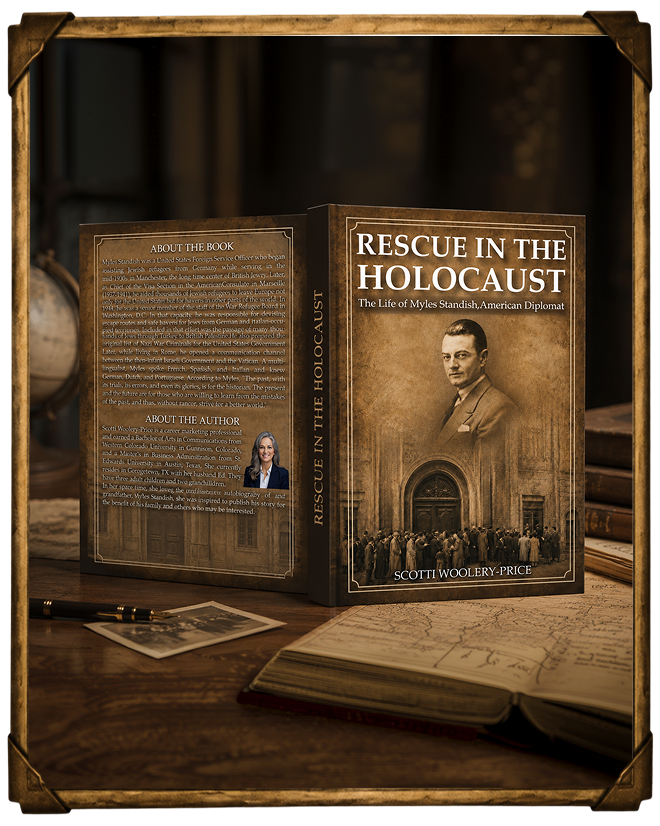
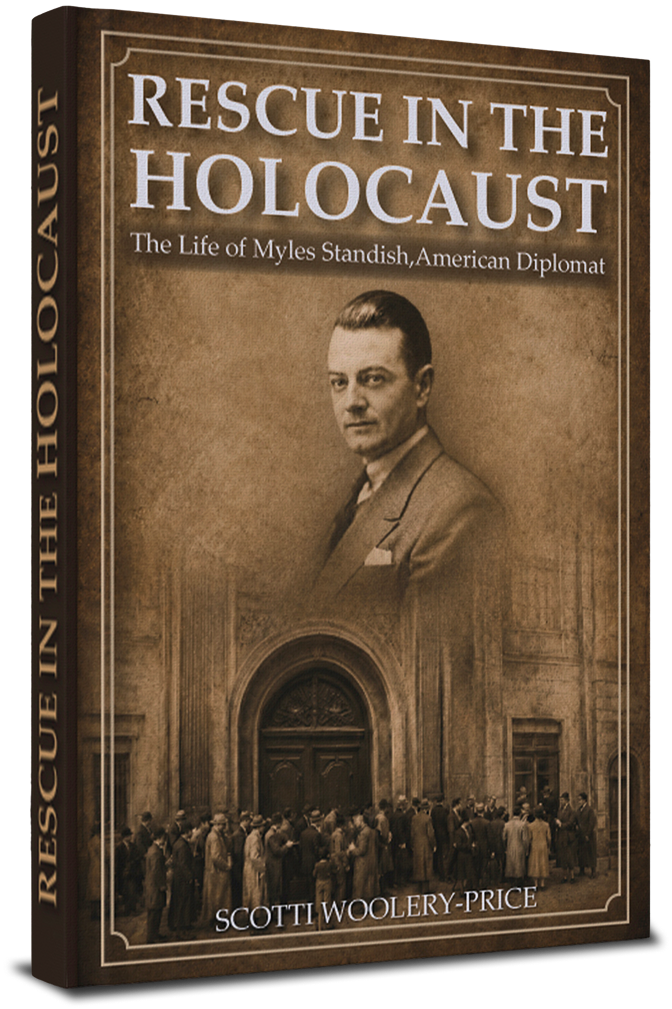
Marseille, 1940. A young American diplomat sat behind a desk with a line of refugees stretching around the block, and a government telling him to slow down. Among the true stories of Holocaust rescue, this is the remarkable account of what he did instead.
Rescue in the Holocaust reveals the true account of Myles Standish and his remarkable role in Holocaust rescue in France. As Chief of the Visa Section at the American Consulate in Marseille, he, alongside his colleague Harry Bingham IV, issued thousands of visas and travel documents to refugees stripped of their citizenship under Nazi rule, who, alongside his colleague Harry Bingham IV, issued thousands of visas and travel documents to refugees stripped of their citizenship under Nazi rule. He did it in direct defiance of a State Department instructed to slow refugee immigration to a crawl.
In a single year, Standish and his small team helped Jewish refugees in Marseille and other victims of Nazi persecution, issuing roughly 8,500 visas and 2,500 Affidavits in Lieu of Passport, more than any other American consulate in France. He worked alongside Varian Fry's Emergency Rescue Committee to get endangered artists and intellectuals out of the country, hid refugees in the boot of his own car on the back roads to Spain, and walked into internment camps to sign papers no one else would.
It cost him his career. The State Department never rehired him. Built from his personal papers, State Department and War Refugee Board archives, U.S. Holocaust Museum records, survivor testimony, and family correspondence, this is a biography that doesn't flatten him into a hero on a pedestal; it gives readers the whole, complicated man who chose humanity over instruction, and paid for it.
"Diplomats had the weapon on hand to meet this attack head-on by offering the innocent victims of the Nazi terror an escape hatch... with a scrap of paper or a seal.", Mordecai Paldi
Inside the Book
Nine Chapters One Untold Reckoning
The book opens in Marseille, July 1940, with more than two thousand five hundred refugees standing in a line that wrapped around the block outside the American Consulate, and a thirty-one-year-old diplomat behind the desk deciding what he was willing to risk to help them. From there, it follows the line itself: the exhausted, desperate people who waited for days, and the quiet toll of watching so many turned away by a system built to say no.
As the war tightens its grip, the story moves through Standish's growing defiance and his involvement in World War II refugee rescue, the visas issued against direct instruction, the internment camps he walked into himself, the refugees hidden in the boot of his own car on the back roads to Spain. It follows him to Washington in 1944, where the choices he made in Marseille finally catch up with him, and into the quieter, harder years afterward, when the world moved on, and his own government never rehired him.
The final chapters turn to what almost didn't survive: how a family nearly lost this story entirely, and how one phone call, decades later, sent his granddaughter back into a trunk of letters and papers to bring it home. By the last page, Rescue in the Holocaust isn't just the record of what Myles Standish did. It's the record of what it took to make sure it wasn't forgotten.
"For the people who stood in line outside the American Consulate in Marseille, France, between 1940 and 1941. And for the ones who never made it inside."
A Desk. A Line. A Choice .
He was never famous for it. He never asked to be. Discover one of the lesser-known Holocaust rescue stories, and the family that spent years making sure the State Department's forgotten history would finally be told.
"I picked this up expecting a history lesson and got something closer to a gut-punch. By chapter three I'd forgotten I was reading nonfiction; I just wanted to know what happened to the people in that line."
Mary Paul
owner
"What got me wasn't the heroism, it was the cost. This isn't a book about a man who did the right thing easily. It's about what it took out of him to do it at all."
Sarah Phill
owner
"I've read a lot of WWII history, and I'd never heard Myles Standish's name before this book. That alone tells you something. It shouldn't have taken this long for his story to surface."